Spare Parts and Accessories for MBK Nitro
Our online shop offers high-quality parts for maintenance, restoration, repairs, or tuning of the MBK Nitro scooter, along with short delivery times and very affordable prices.
Engine Parts for MBK Nitro
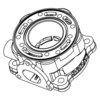
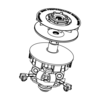
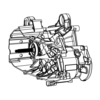
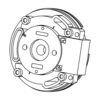
The Nitro has a liquid-cooled, horizontal Minarelli engine. This 50cc scooter engine is very common and popular among tuners, making parts for maintenance and / or tuning easy to find.
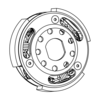
There is one important point to note: models from 1997 to 1999 may have either a two-shoe clutch with a diameter of 105 mm or a three-shoe clutch with a diameter of 107 mm. The installed clutch therefore needs to be checked before ordering certain parts.
- Genuine manufacturer parts: OEM parts from Yamaha / Minarelli
- OEM-quality engine parts / standard replacement parts: aftermarket pistons, gasket sets, spark plugs, drive belts, various bearings, etc.
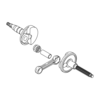
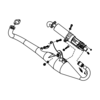
- Sport and racing components: 50cc, 70cc, and other cylinder kits, reinforced crankshafts, sport variators, inner rotor ignitions, racing exhausts, etc.
We stock high-quality parts from well-known brands such as Motoforce, Stage6, Malossi, Polini, Airsal, Top Performances, and many more.
Chassis and Bodywork Parts for Nitro 50
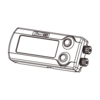
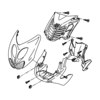
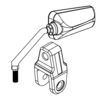
- Body panels, headlights, rear light, handlebars, handlebar mount, seat, seat cover, speedometer, etc.: the scooter's entire appearance can be refreshed.
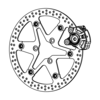
- Brake shoes, brake discs and pads, fork and shock absorbers, steering head bearings, engine mounts: everything needed to restore the chassis to working order.
Frequently Asked Questions:
Which variator rollers does the MBK Nitro need?
The Nitro comes with 15 x 12 mm variator rollers weighing 5.4 g. After fitting a sport exhaust, the roller weight should be reduced to around 4.5 g. On a used scooter, the roller size needs to be checked first, as many sport variators use 16 x 13 mm rollers.
Which springs should be used?
The stock contra spring should only be replaced with a stiffer one on heavily tuned engines. The stock clutch springs, however, need to be replaced with stiffer springs in several cases:
- After fitting a sport exhaust: the engine produces less power at low rpm. The clutch needs to engage at higher rpm to compensate.
- After fitting a racing cylinder: the more the cylinder's power curve favors high rpm, the higher the clutch engagement speed needs to be.
Kits containing several sets of springs with different stiffness ratings are recommended for testing different setups. This allows brisk starts without losing control.
Which spark plug is suitable?
The engine uses M14 long-reach spark plugs. The heat range depends on the engine: an NGK B7ES or equivalent spark plug is sufficient for a stock engine. A colder plug such as the B8ES is suitable for a mildly tuned engine. A B9ES can be used in a racing engine.
Which two-stroke oil is suitable?
This depends on the engine: semi-synthetic two-stroke oil is sufficient for a stock engine. A tuned engine needs fully synthetic oil. A racing engine requires high-quality racing oil.
Which CDI, stator, or voltage regulator fits?
The Nitro / Aerox and Booster / BW's, along with many other scooters with a Minarelli engine and Yamaha ignition, use the same ignition setup. The CDI and all ignition components from model years before 2004 are compatible.
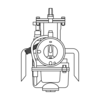
Which exhaust or carburetor is suitable?
This depends entirely on the cylinder. Here are a few examples:
- Stock cylinder or 50cc sport cylinder: carburetor up to 17.5 mm and a sport exhaust.
- 70cc sport cylinder: carburetor up to 21 mm and a sport exhaust.
- Racing cylinder up to 70cc: carburetor diameter between 19 mm and 28 mm, depending on displacement. Racing exhaust matched to the displacement.
- High-end racing cylinder 70cc or more: carburetor matched to the displacement, up to 36 mm. Exhaust matched to the chosen cylinder.
Are all parts interchangeable between Nitro models from 1999 to 2002?
No. As mentioned above, the clutch may differ. The steering stem diameter also needs to be checked before replacing the bearings.
Does the Nitro have a manual or automatic choke?
The early versions have a manual choke, operated by a small lever on the left side of the handlebars. In this case, the carburetor has no electrical connection.
Newer versions with an automatic choke do not have this lever. Instead, they have an electrical connection on the carburetor.