Spare Parts and Accessories for Piaggio Zip from 2000
Our online shop offers spare parts for the maintenance, repair and tuning of the Piaggio Zip 50cc two-stroke from 2000 onward. The range includes high-quality parts, short delivery times and affordable prices.
Engine Parts for Piaggio Zip from 2000
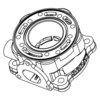
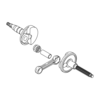
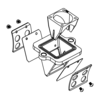
The Piaggio Zip 2 with a 50cc two-stroke engine is equipped with an engine that is very common in the scooter world: the air-cooled Piaggio Hi-Per2. There is accordingly a wide selection of parts for maintenance and tuning:
- Original manufacturer parts: Piaggio OEM parts, available in the exploded diagrams
- Standard replacement parts in OEM quality: affordable aftermarket parts, pistons, gasket sets, spark plugs, drive belts, various bearings and more
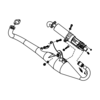
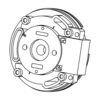
- Sport and racing components: 50cc and 70cc cylinders, reinforced crankshafts and clutches, variators, inner rotor ignitions, racing exhausts and more
Chassis Parts for Zip 2
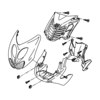
- Body panels: aftermarket parts with the original look or tuning versions, available as sets or individually, in many colors
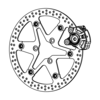
- Chassis parts: brake shoes, brake pads and discs, cables, levers, steering head bearings, shock absorbers and more
We stock high-quality products from well-known brands such as Motoforce, Stage6, Malossi, Polini, Airsal, Top Performances and many others.
Frequently Asked Questions:
What is the difference between the Zip 50 2-stroke and the Zip 50 4-stroke?
The engine. The four-stroke engine can be identified by the following detail: below the variator cover, near the bodywork, there is an opening for checking the oil level. The two-stroke engine does not have one.
Note: The Euro 5 and I-Get versions have a 4-stroke engine.
What is the difference between a standard Zip and a Zip SP?
The Zip SP has a single-sided swingarm and a front grille, behind which sits the radiator for the liquid cooling system. The standard Zip does not have these features.
How is the engine restricted?
There is usually a restriction in the CDI that limits the maximum engine speed. There is also a restriction in the exhaust that obstructs the flow of exhaust gases. The variator is restricted too: a ring behind the ramp plate prevents it from opening fully.
What changes if only the variator is derestricted?
Even if the transmission can then open fully, the engine speed remains limited and the exhaust flow is still too heavily restricted. For a good result, the variator restrictor ring must be removed and a performance exhaust used.
How much more power is possible with the stock cylinder?
Even without changing the cylinder, a significant increase in power is possible with, among other things:
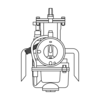
- Sport exhaust → The carburetor must be retuned with a larger main jet. Stiffer clutch springs are also needed.
- Sport variator with optimized ramp tracks → The variator roller weight must be adjusted correctly.
- Unrestricted CDI (essential) to reach a higher engine speed
This results in better acceleration and a higher top speed.
Which exhaust is suitable for a Zip 2T in stock condition?
An exhaust with the original look or a sport exhaust for a little more power can be used. A sport exhaust requires the variator, clutch and carburetor to be tuned accordingly.
What adjustments are needed after fitting a performance exhaust?
A sport exhaust requires a main jet approximately 5 to 10 sizes larger. A jet set is needed to test different jets. Slightly lighter variator rollers (1 to 1.5 g less) and stiffer clutch springs are also needed so that the clutch opens only at a higher engine speed.
What weight and dimensions should the variator rollers have?
On the Zip from 2000 onward, the variator rollers measure 19 x 15.5 mm. The stock rollers weigh 7.5 g.
Do parts from other Piaggio scooter engines fit the Zip?
Yes, provided they come from air-cooled Piaggio scooters manufactured from August 1998 onward with short crankcases. Note: the air-cooled Typhoon shares many parts with the Zip, including the cylinder, exhaust and variator. However, it has larger wheels, different crankcases and a different drive.
Which two-stroke oil is suitable?
This depends on the engine: a semi-synthetic two-stroke oil is sufficient for a stock engine. A tuned engine needs a fully synthetic oil. A racing engine requires a high-quality racing oil.
Which oil is used for the final drive?
The answer can be found further down this page in the vehicle's technical specifications.