Skip to content
Scooter
50cc Bike
Moped
Motocross

The Motorcycle Clutch – The Link Between Engine and Gearbox

How a Motorcycle Clutch Works

The purpose of the clutch is to separate or connect the engine and the gearbox. Pulling the clutch lever interrupts the connection between the engine and the gearbox. Releasing the clutch reconnects the engine and the gearbox.

To understand the function in detail, it helps to examine the core components and their specific roles.

The friction plates, which are fitted with a lining, are driven by the clutch basket (via the outer grooves), which in turn is driven by the crankshaft. The steel plates, on the other hand, drive the clutch hub (via the inner grooves), which then drives the gearbox. The steel plates are not in direct contact with the basket, and the friction plates have no direct contact with the hub.

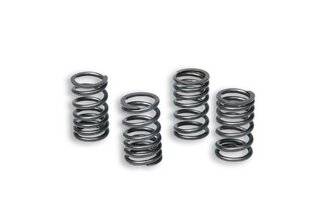
When you pull the clutch, you activate a mechanism that presses against the pressure plate. The springs are compressed, and the steel plates and friction plates no longer touch. The crankshaft can then no longer drive the gearbox.

As soon as you release the clutch lever, the springs press the pressure plate with full force against the plate pack. This pressure creates friction between the friction and steel plates, so that they connect and rotate together. This rotational movement is transmitted directly to the hub, which in turn drives the gearbox and thus your rear wheel.

The materials of the friction plates therefore have high friction coefficients to ensure grip between the plates.

Motorcycle Clutch and Engine Tuning

When performance increases, the clutch must be adapted accordingly. An inferior clutch is unable to transmit the power correctly, and even if it does not slip, it will wear out too quickly.

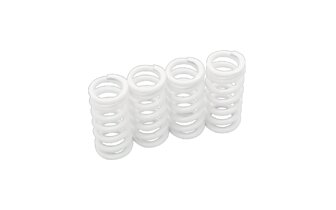
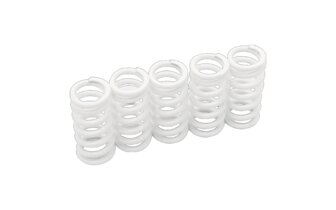
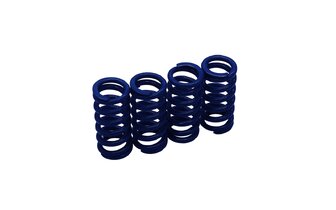
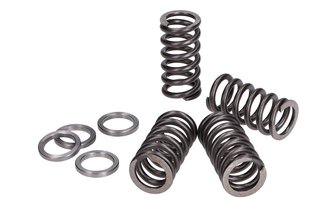
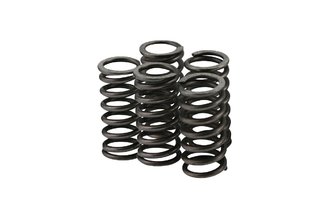
To counteract this, there are various solutions: reinforced friction linings on the friction plates, harder springs that create stronger contact pressure on the pressure plate and plates, or an overall larger clutch with more friction surface and contact area (larger number of plates and springs).

Note: This explanation can easily be observed on motorcycles → a 50cc motorcycle has a smaller clutch with 4 or 5 friction plates and usually 4 springs. A 450cc machine has a large clutch with 7 or 8 plates and 5 to 6 springs.

Recommendations:

Depending on the tuning level (configuration), it is not always necessary to replace the complete clutch.

  • Have you installed a sport cylinder? Opt for reinforced plates and springs
    Example → MotoForce Racing, Stage6 ...
  • Have you installed a cylinder with significantly more displacement or a racing cylinder? A reinforced clutch kit is recommended here, possibly with more plates
    Example → Stage6 R/T, MVT, KRM ...
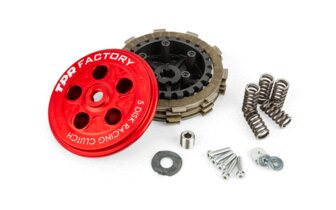
  • Have you built a racing setup with a high-end cylinder with large displacement? Then a complete clutch kit is ideal, with a special clutch basket, hub and pressure plate as well as a larger number of plates and springs.
    Example → complete Top Performances TPR kit

Note: If you are running a standard engine or only derestrict the engine, a clutch in OEM quality (for example from MotoForce) is usually sufficient.

Identifying Faults and Wear

Before looking at the internal clutch parts, the clutch actuation should also be considered. If your clutch lever is difficult to pull, the clutch cable may simply be frayed and no longer sliding properly in its housing.

The lever and cable can also give you a hint about the condition of the clutch plates. Explanation: With a new clutch and correctly adjusted cable tension, there is a certain amount of play at the lever. If this play decreases and you have to readjust the cable to restore it, this is a possible sign of wear.

A key symptom of wear is a clutch that slips almost constantly. When the engine revs up, it screams, yet it feels as though you are riding with the brake applied or the clutch partially engaged, preventing you from reaching top speed.

Note: If the clutch is too weak or too small for your setup, the symptoms can be the same.

Tip: To maintain a smooth clutch, you should lubricate the Bowden cable (inside the housing). There are special tools for this, with which cables can be greased with spray lubricant.
To protect the plates, carry out regular gearbox oil changes, at least at the intervals recommended by the manufacturer, and use a high-quality oil.

50cc Motorcycle Clutches in Our Shop:

In our online shop, you will find everything you need to maintain, repair and optimise the clutch of your 50cc supermoto / enduro bike. We offer complete clutch kits, both in standard and reinforced versions, as well as all clutch components individually: springs, basket, hub, plates, etc. These parts come from renowned manufacturers such as Malossi, Top Performance, Stage6, Motoforce and are of course available for all popular models such as Rieju MRT, Derbi Euro3, Beta RR, Sherco SM etc.

Add your bike
Display only products that match your vehicle. Simply select your vehicle type, make and model. You can also simply add it to your garage to access it later.

Clutch

(125 products)
Shopping cart

JavaScript ist in Ihrem Browser deaktiviert.
Bitte aktivieren Sie JavaScript um unseren Webshop nutzen zu können und laden diese Seite erneut.

Back to top
Categories
Products